Should you still pay to build a CNC quoting tool?
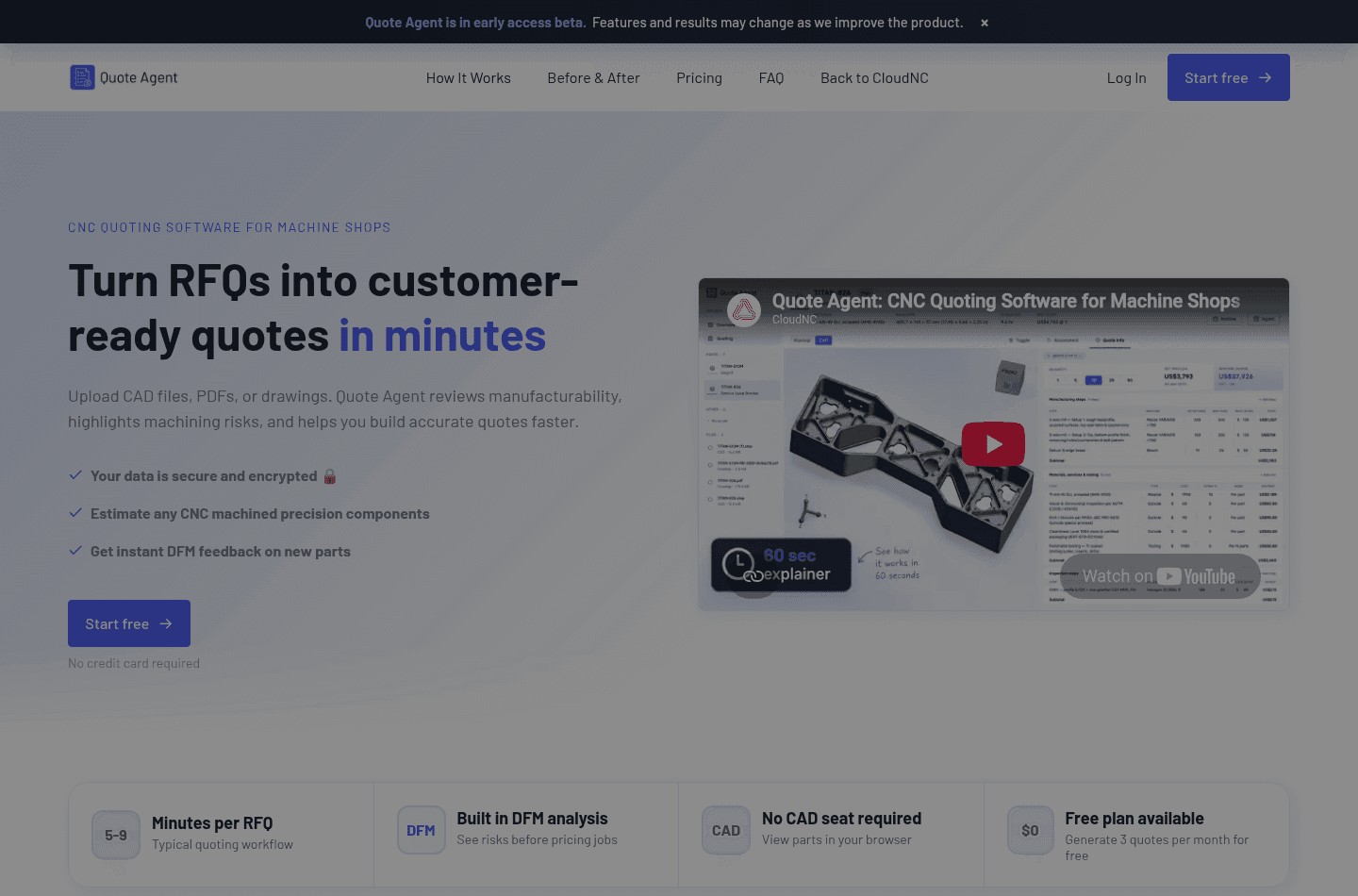
No — not for the estimating itself. CloudNC's Quote Agent is live today, with a free tier and ten parts on sign-up, and it prices at $2.50 a part on a $20-a-month single-user plan or $2.40 on the multi-user one. Any bespoke quoting engine now has to beat that per part, and beat a first draft quote produced from a CAD file or a drawing in five to nine minutes. Very little in-house work will.
The money is better spent on the four things it does not do, and on one clause you should settle before a controlled drawing arrives.
What it costs
| Quote Agent plan | Per month | Parts a month | Per part | Overage |
|---|---|---|---|---|
| Free | $0 | 3, plus 10 on sign-up | — | — |
| Starter, single user | $20 / $50 / $100 | 8 / 20 / 40 | $2.50 | $3.75 |
| Professional, multi-user with SSO | $200 / $500 / $1,000 | 83 / 208 / 416 | $2.40 | $3.60 |
Upload CAD files and drawings, or forward customer enquiries straight to a Quote Agent inbox. It reviews each part, flags machining risk, drafts a quote you can edit, and exports a PDF. No CAM seat and no CAD seat are required — it runs in a browser, whatever CAD, CAM or ERP you already have. It covers 3-axis, 3+2, 4-axis and 5-axis mills, horizontal mills, CNC lathes, turn-mill machines and Swiss lathes, plus grinding and finishing, EDM, cutting and forming, and inspection. CloudNC puts its own workflow at five to nine minutes against two to four hours done by hand.
It is in early access beta, which is an argument for trialling it on ten real enquiries this week rather than for waiting. Ten parts costs nothing and answers the only question that matters: how close its draft lands to the price your estimator would have written.
What is still worth building
Four things, and none of them are geometry.
- The link to your ERP or CRM. A quote has to become a job, a bill of materials and an invoice without anyone retyping it. Quote Agent exports a PDF; the rest is yours.
- The approval chain. Who may sign a price, above what value, and what happens when the estimator and the owner disagree. A tool that drafts in minutes makes this more urgent, not less.
- The audit trail. Which revision of which drawing produced which price, and who moved the markup. A quote produced in nine minutes carries exactly the liability of one that took three days.
- The judgement that is not the part. This customer's payment history, the rush premium, the repeat-order discount. That is where a shop makes or loses the margin, and no one is selling it at $2.40.
The clause to settle before a controlled drawing arrives
Quote Agent's own FAQ is blunt about it:
"At this time, Quote Agent is a cloud-based service and we do not recommend uploading export-controlled data." — CloudNC, Quote Agent FAQ
One click away, the CAM Assist pricing page lists "High security (GovCloud available)" on its Job Shop tier and an option to use AWS GovCloud (US) for ITAR work. Same company: one product has a government-cloud route, the other tells you to keep those drawings out. CloudNC's latest round, $20 million led by Nimble Ventures, included LM Capital — Lockheed Martin's venture arm — so that gap is likely to close, but it is open now.
Which means: if any of your customers work to ITAR or an equivalent regime, write into the agreement which cloud their files may land in, and who is liable if one lands elsewhere. The market leader has already published its own position. Your customer's lawyer will find it, and it is a far easier conversation to have first.
If what you actually need is the quoting workflow wired into the ERP you already run, rather than an estimating engine rebuilt from scratch, that is the work Vesprr's software division does.
Sources
- CloudNC, Quote Agent, read 24 September 2026: the live sign-up, the plan and per-part pricing, the five-to-nine-minute workflow, the supported machine types and the export-control FAQ answer.
- CloudNC, CAM Assist pricing: the "High security (GovCloud available)" line on the Job Shop tier and the AWS GovCloud (US) option for ITAR.
- Dominic-Madori Davis, CloudNC raises $20M to automate manufacturing's most pressing bottlenecks, TechCrunch, 8 September 2026: the $20 million Series B extension, Nimble Ventures leading, LM Capital in the round.