Claude Opus 5.5 pricing: $4 in, $20 out, and what a job costs
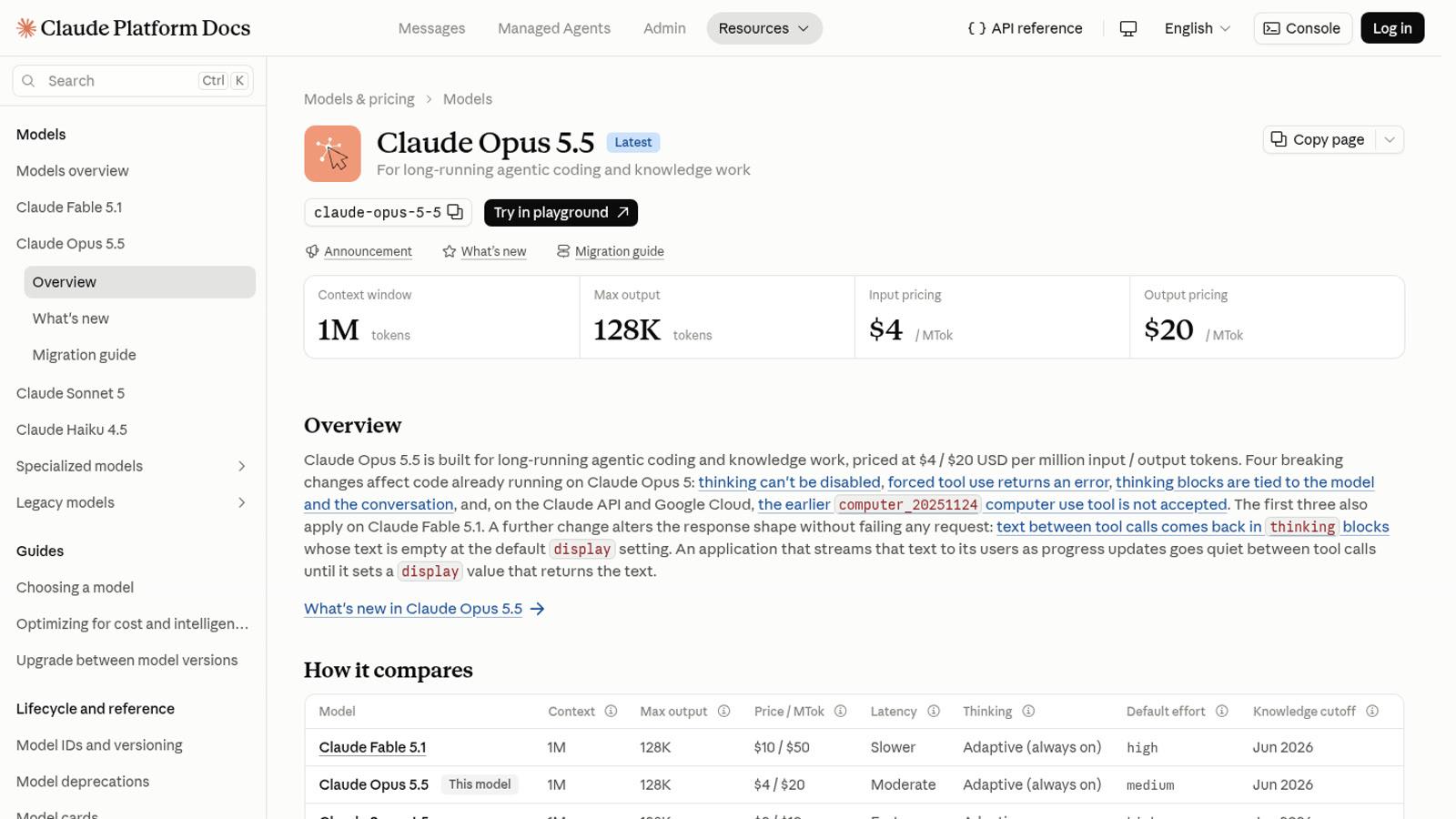
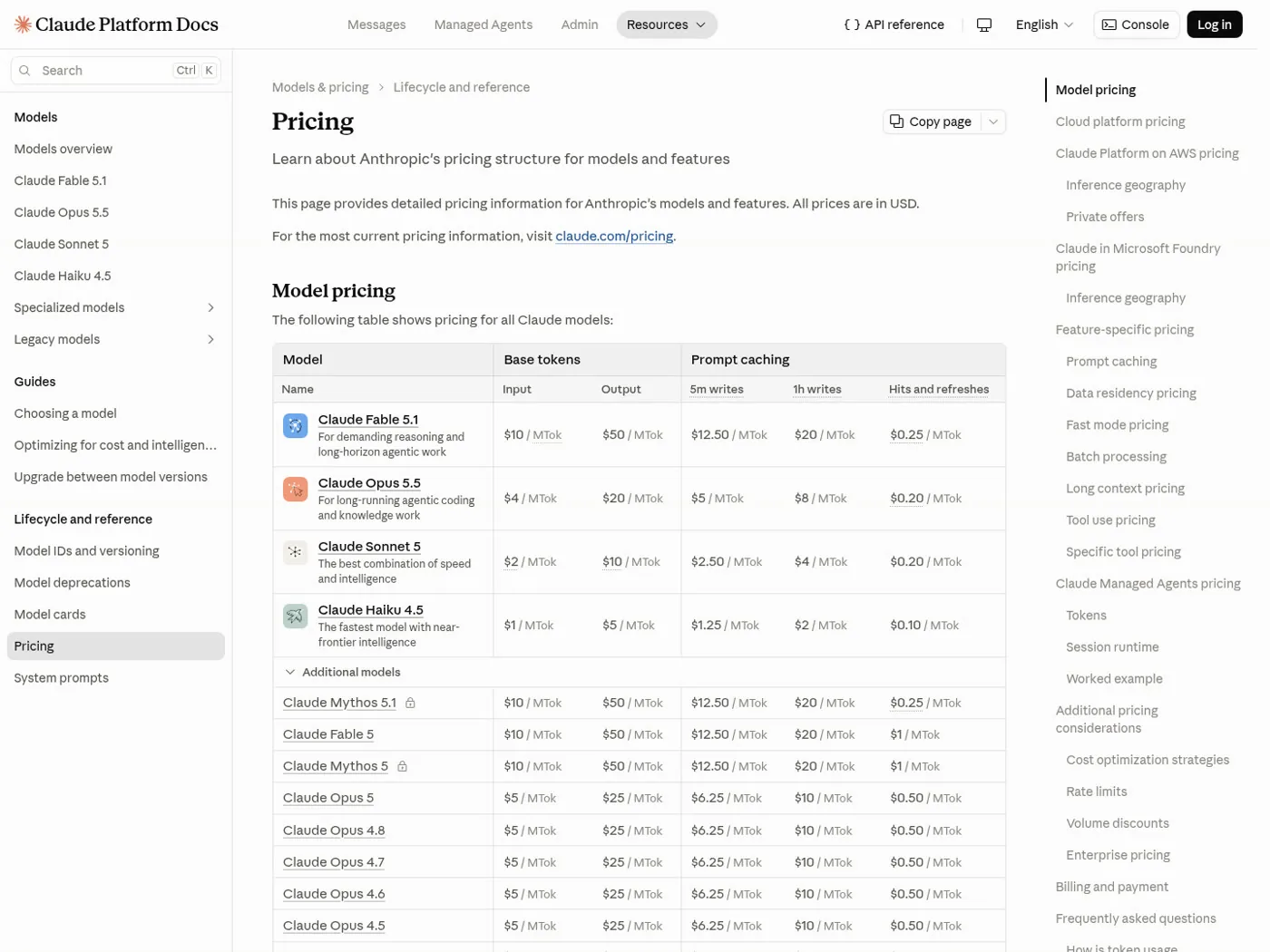
Claude Opus 5.5 costs $4 per million input tokens and $20 per million output tokens on Anthropic's API. Reading from the prompt cache costs $0.20 per million, and the Batch API halves input and output to $2 and $10. Those are Anthropic's published prices, read on 25 September 2026, and they are 20% below Opus 5 on input and output.
The per-token price is only half the bill. On Opus 5.5 thinking is always on, and thinking tokens are charged as output. For most jobs, output is where the money goes.
What each part of the bill costs
You pay per million tokens (MTok), and there are six prices to know:
- Input: $4 / MTok. The full 1M-token context window is billed at this same rate; there is no long-context surcharge.
- Output: $20 / MTok, including thinking you never see.
- Cache writes: $5 / MTok for a 5-minute cache, $8 for a 1-hour cache.
- Cache reads: $0.20 / MTok, 5% of the input price. On most Claude models a cache read is 10%.
- Batch API: 50% off input and output, for jobs that can wait for an answer.
- Fast mode: $8 input and $40 output, up to 2.5x faster output. It is a research preview, only on Anthropic's own API, and not available with Batch.
Two multipliers stack on top. Keeping inference in the US with inference_geo: "us" adds 10% to every line. Amazon Bedrock and Google Cloud set their own regional prices, so check theirs if you buy through them.
What a real job costs
Take a document job: 10,000 contracts or support tickets a month. Each call sends the same 5,000 tokens of instructions and examples, plus a 2,000-token document, and gets back 1,500 output tokens. That output figure includes thinking and is an assumption; measure yours at the effort level you pick.
- Documents: 10,000 × 2,000 = 20M input tokens × $4 = $80
- Instructions, read from cache: 10,000 × 5,000 = 50M tokens × $0.20 = $10 (cache writes add a few cents: 5,000 tokens at $5 per million is $0.025 a write)
- Output: 10,000 × 1,500 = 15M tokens × $20 = $300
That is about $390 a month. Without the cache, the instructions cost 50M × $4 = $200 instead of $10, and the month comes to $580. Sent through the Batch API with the cache hitting, every line halves: about $195.
Output is $300 of the $390. The lever on it is the effort parameter (low, medium, high, xhigh, max). The default on Opus 5.5 is medium, where Opus 5 defaulted to high. Setting it higher buys more thinking, and you pay for every token of it.
How it compares
Here are the models you are most likely weighing it against, all read from the same page today:
| Model | Input | Output | Cache read | Batch in / out |
|---|---|---|---|---|
| Claude Fable 5.1 | $10 | $50 | $0.25 | $5 / $25 |
| Claude Opus 5.5 | $4 | $20 | $0.20 | $2 / $10 |
| Claude Opus 5 | $5 | $25 | $0.50 | $2.50 / $12.50 |
| Claude Sonnet 5 | $2 | $10 | $0.20 | $1 / $5 |
At the same token counts, the job above costs $500 on Opus 5 and $200 on Sonnet 5. Anthropic says Opus 5.5 also uses fewer tokens per task than Opus 5, and puts the saving on typical workloads at 40%. That is the vendor's own test, not a price. Your figure comes from running your own prompts on both.
"Our tests show that at default settings it will cost 40% less than Opus 5 on typical workloads."
— Anthropic, Introducing Claude Opus 5.5
If you are moving an Opus 5 workload that ran with thinking turned off, expect more output tokens, not fewer. Opus 5.5 rejects thinking: {"type": "disabled"}, so lower the effort level instead. The migration guide says to re-baseline cost and latency at the effort you choose. Pick Sonnet 5 when the task is routine and volume is high. Pick Opus 5.5 when a wrong or half-finished answer costs you more than the price gap.
On claude.ai, Opus 5.5 comes with the Pro, Max, Team and Enterprise plans, and Anthropic raised their five-hour usage limits at launch. Those plans are for people using Claude. A product you build is billed per token on the API.
If you want Opus 5.5 built into your product or workflow, with the effort level and caching set up to keep the bill down, see what Vesprr builds or tell us about the job.
Sources
- Introducing Claude Opus 5.5, Anthropic, 22 September 2026 (launch prices, 40% cost claim, plan limits)
- Pricing, Claude Platform Docs, read 25 September 2026 (every price, cache, batch, fast mode and data-residency figure)
- Claude Opus 5.5 overview, Claude Platform Docs, read 25 September 2026 (default effort, always-on thinking, model id
claude-opus-5-5) - Migrating to Claude Opus 5.5, Claude Platform Docs, read 25 September 2026 (thinking billed as output, disabled thinking rejected)
- Demand signal, not a source of any figure: Claude Opus 5.5 is ridiculous, AI Search, and Claude Opus 5.5 fully tested, WorldofAI
- More in this series: AI models on Vesprr