Kimi K3.1 Pro pricing: $2 in, $10 out, and what a job costs
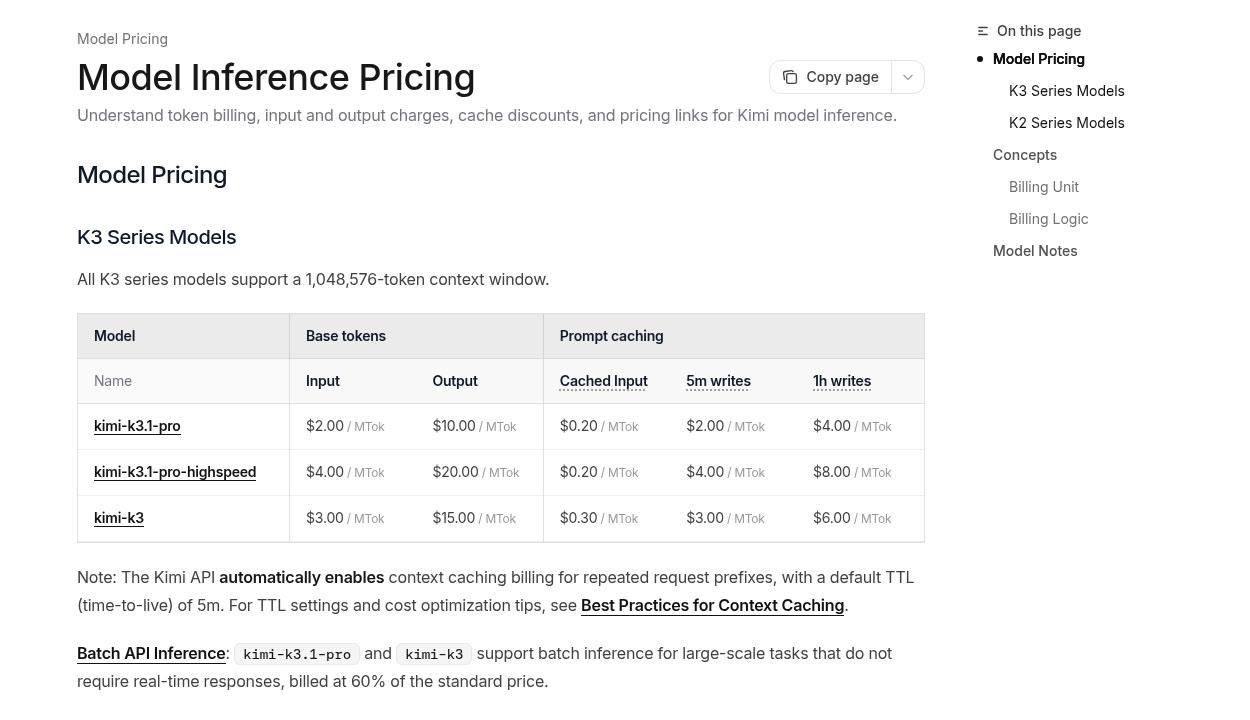
Kimi K3.1 Pro costs $2 per million input tokens and $10 per million output tokens on Moonshot AI's API. Input that hits the cache costs $0.20 per million, and batch jobs cost 60% of the normal price. That is half the list price of Claude Opus 5.5 and the same as Claude Sonnet 5.5, so what you actually pay depends on how much of each request is cached and how many tokens the model writes.
The prices below come from Moonshot's pricing, caching and batch pages, read on 4 November 2026. They exclude tax.
What does each line on the bill cost?
There are five lines, plus a faster variant. Moonshot says kimi-k3.1-pro-highspeed runs 2-3 times faster for twice the price.
| Per million tokens | kimi-k3.1-pro | Highspeed | Batch (kimi-k3.1-pro) |
|---|---|---|---|
| Input | $2.00 | $4.00 | $1.20 |
| Output (answer and reasoning) | $10.00 | $20.00 | $6.00 |
| Cached input | $0.20 | $0.20 | $0.12 |
| Cache write, 5-minute | $2.00 | $4.00 | $1.20 |
| Cache write, 1-hour | $4.00 | $8.00 | $2.40 |
Caching is on by default. When you send the same opening text again (a system prompt, a manual, a codebase), the first request pays the cache-write price and every repeat within the time limit pays $0.20. Each hit resets the timer. The 5-minute write costs the same as normal input, so you pay nothing extra for it. Choose the 1-hour write only when repeats arrive more than five minutes apart.
Batch requests are processed in the background and must finish inside the window you set. Moonshot says cache hits in batch are "best effort", so do not count on the $0.12 rate there.
What does a real job cost?
Take a support assistant that answers 1,000 questions a day from a 50,000-token product manual. Each question adds 500 tokens, and each reply is 2,000 tokens of reasoning and answer. Traffic is steady, so the manual is written to the cache once and hit 999 times.
- Cache write: 50,000 × $2 ÷ 1,000,000 = $0.10
- Cache hits: 999 × 50,000 = 49,950,000 tokens × $0.20 ÷ 1,000,000 = $9.99
- Questions: 1,000 × 500 = 500,000 tokens × $2 ÷ 1,000,000 = $1.00
- Replies: 1,000 × 2,000 = 2,000,000 tokens × $10 ÷ 1,000,000 = $20.00
Total: $31.09 a day. Without the cache, all 50.5 million input tokens cost $2 per million, and the day costs $101.00 + $20.00 = $121.00.
The same job on other models, at prices read on their pages on 4 November and assuming the same number of tokens:
- K3.1 Pro Highspeed ($4 in, $20 out, $0.20 cached, $4 write): $0.20 + $9.99 + $2.00 + $40.00 = $52.19
- Claude Opus 5.5 ($4 in, $20 out, $0.20 cached, $5 write): $0.25 + $9.99 + $2.00 + $40.00 = $52.24
- Claude Sonnet 5.5 ($2 in, $10 out, $0.10 cached, $2.50 write): $0.125 + $4.995 + $1.00 + $20.00 = $26.12
On a cache-heavy job, Sonnet 5.5 comes out cheaper because its cached input costs half as much. K3.1 Pro's price advantage is over Opus 5.5.
Why might your bill be higher?
Output is the line that grows. K3.1 Pro always reasons, its reasoning_effort defaults to max, and Moonshot's docs confirm reasoning tokens are billed as output. Artificial Analysis found it "somewhat verbose": it generated 110 million tokens running that firm's Intelligence Index, against a median of 73 million. If your replies run 50% longer, the example's output line rises to 3,000,000 × $10 ÷ 1,000,000 = $30.00, and the day to $41.09.
Three settings keep it down:
- Set
reasoning_efforttoloworhighwheremaxis not needed, and measure tokens on your own prompts. - Put fixed content first and changing content last. The cache matches from the start of the request, so a timestamp near the top breaks every hit.
- Send overnight work, such as tagging or report drafts, through the Batch API at 60%.
Two account limits affect your budget. The API needs a $1 minimum top-up, but at that level you are limited to 1.5 million tokens a day and 3 requests a minute. The example above needs about 52.5 million tokens a day, so plan on the $10 tier, which removes the daily cap. The cheaper K2 models ($0.95 in, $4 out) are closed to new accounts since 31 October and retire at the end of December, so they are not an option for a new project.
Want Kimi K3.1 Pro built into your product or workflow, with its real token use measured against the model you pay for now? See what we build or tell us about the job.
More on this model: What is Kimi K3.1 Pro? Moonshot AI's new flagship model.
Sources
- Moonshot AI, Model inference pricing (read 4 Nov 2026)
- Moonshot AI, Best practices for context caching (read 4 Nov 2026)
- Moonshot AI, BatchJob pricing (read 4 Nov 2026)
- Moonshot AI, Reasoning effort and Thinking models (read 4 Nov 2026)
- Moonshot AI, Recharge and rate limits (read 4 Nov 2026)
- Moonshot AI, Introducing Kimi K3.1 Pro (23 Oct 2026)
- Anthropic, Pricing (read 4 Nov 2026)
- Artificial Analysis, Kimi K3.1 Pro (read 4 Nov 2026)
- WorldofAI, Kimi K3.1 Pro Is INSANE! CHEAPER & FASTER Than Claude Opus 5.5?! (Fully Tested) (video)