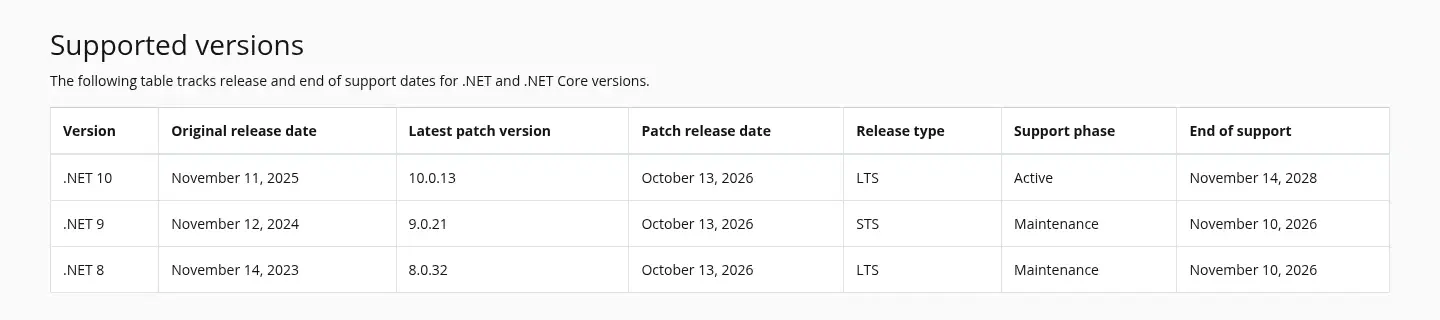
.NET 8 end of support: what to do before 10 November
On 10 November 2026 Microsoft stops patching .NET 8 and .NET 9. An app built on either will keep running, but any security hole found after that date stays open. Ask whoever maintains the app to move it to .NET 10, the current long-term release, which Microsoft supports until 14 November 2028. For most apps it is a contained job, not a rebuild. Book it now, so the testing happens before the date and not after it.
Microsoft's announcement is plain about the risk:
"Staying on an unsupported version means you are exposed to security vulnerabilities that will not be patched."
Rahul Bhandari, Microsoft .NET Blog, 29 June 2026
Is your app on .NET 8 or 9?
Ask your developer or vendor two things for every app you run: which .NET version it targets, and where it is hosted. The version is in the project file, on a line such as <TargetFramework>net8.0</TargetFramework>. On a server, the command dotnet --list-runtimes lists the runtimes installed.
Two cases are different:
- .NET Framework 4.8 is not affected. The name is similar, but it is a separate, older product. Microsoft treats it as part of Windows, so it stays supported as long as the version of Windows it is installed on is supported.
- Software you bought, rather than had built. You cannot upgrade it yourself. Microsoft's advice is to ask the vendor for a version that runs on .NET 10. Put that question in writing and ask for a date.
How big a job is the upgrade?
Usually smaller than owners fear. Microsoft's upgrade guide says the only change the code strictly needs is that one line in the project file, changed to net10.0. The development machines, the build pipeline and the server or cloud service then need the .NET 10 runtime too.
Four things turn it into a bigger job. Ask your developer about each one before agreeing a date:
- Two sets of breaking changes. An app jumping from 8 to 10 skips .NET 9, so it picks up the breaking changes of both releases. Microsoft publishes a list for each. Most of the .NET 10 entries are changes in behaviour, not code that stops compiling, which is why the testing matters more than the edit.
- Third-party packages. Every library the app uses needs a version that supports .NET 10. An abandoned one has to be replaced, which adds work nobody planned for.
- Azure Functions on the in-process model. Microsoft ends support for that model on the same day, 10 November 2026. Moving to the isolated worker model means changing the code of each function, not one line.
- Containers. In .NET 10, Microsoft's default container images are based on Ubuntu instead of Debian. A Dockerfile that installs extra system packages may need changing.
Then test the whole app as users use it: logins, payments, reports, exports, anything that talks to another system. A clean compile proves very little.
Should you wait for .NET 11?
No. .NET 11 is due at Microsoft's .NET Conf on 10 to 13 November, the same week your support ends, so there is no time to test against it. It is also a short-term release. Under Microsoft's policy that means two years of support, which ends at about the same time as .NET 10's in November 2028. Waiting gains you nothing and costs you the testing window. Move to .NET 10 now. Your next upgrade decision is then due in 2028.
What if it is not done by 10 November?
Nothing stops on the day. Microsoft says .NET 8 and 9 apps "will continue to run", and Azure App Service keeps running them unchanged. The risk is in the months after. Each security fix Microsoft ships for .NET 10 from then on skips your app, and each published fix describes a flaw your version may still have.
If you cannot do everything by the date, do the apps on the public internet first: the customer portal, the online shop, the API a partner calls. An app only staff can reach on the office network can follow.
No developer to ask, or no answer yet? Make the list: each app, its .NET version, where it runs and who maintains it. Then send it to Vesprr Software and ask for a quote to upgrade and test each app before 10 November.
Sources
- Rahul Bhandari, Microsoft .NET Blog, .NET 8 and .NET 9 will reach End of Support on November 10, 2026, 29 June 2026.
- Microsoft, .NET and .NET Core Support Policy: release and end-of-support dates, LTS and STS terms. Header image: the supported-versions table from this page, 17 October 2026.
- Microsoft Learn, Upgrade to a new .NET version.
- Microsoft Learn, How to check that .NET is already installed.
- Microsoft Learn, Breaking changes in .NET 9 and Breaking changes in .NET 10.
- Microsoft Learn, Migrate C# apps from the in-process model to the isolated worker model.
- Microsoft Learn, Language runtime support policy for App Service.
- Microsoft, .NET Framework official support policy.
- Microsoft Learn, Default .NET images use Ubuntu.