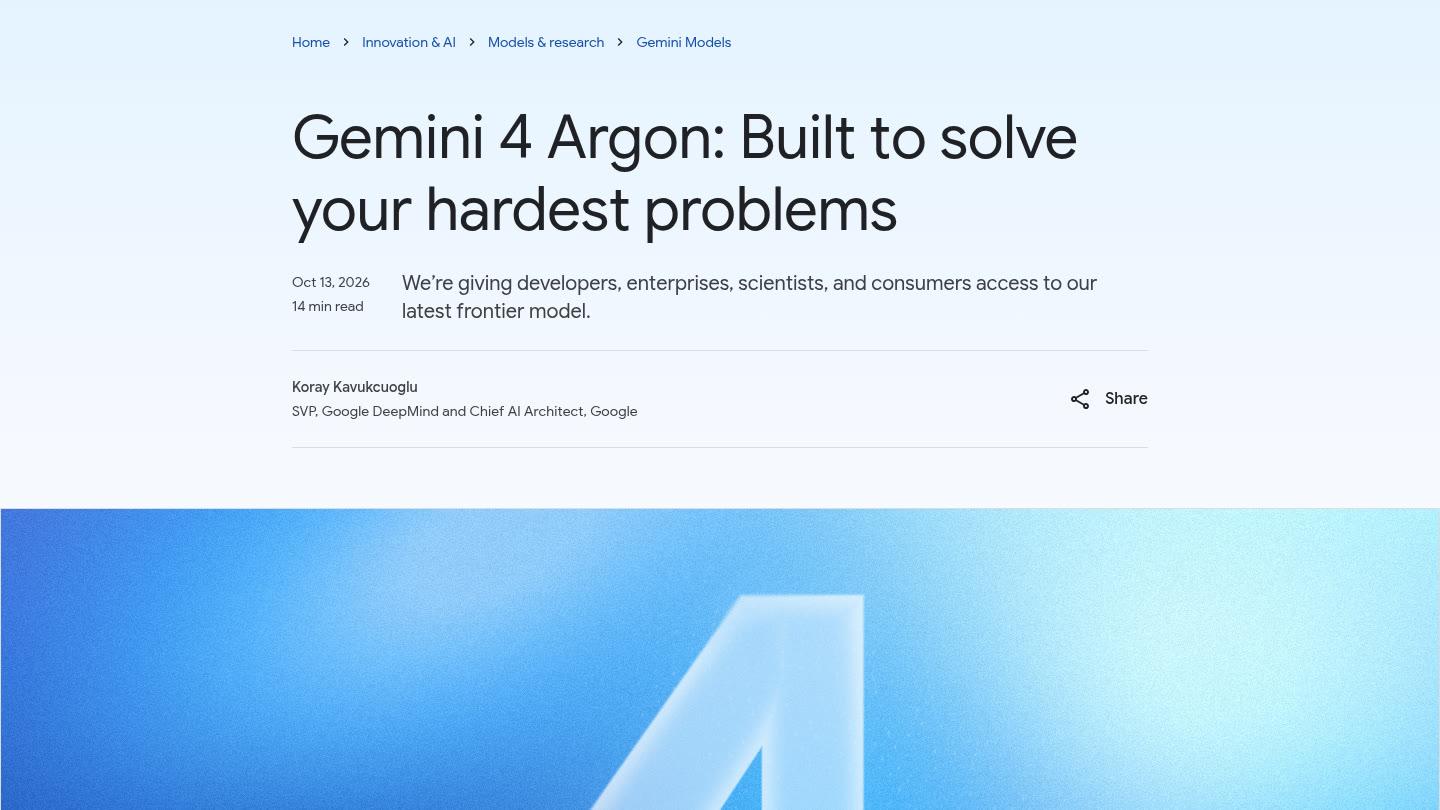
What is Gemini 4 Argon? Google's model for long, hard tasks
Gemini 4 Argon is Google's most capable model, built for long, hard work: large code changes, multi-step agents, and research in fields like finance and law. It became generally available on 13 October 2026 through the Gemini API and Google AI Studio, and in the Gemini app for Google AI Pro and Ultra subscribers. Through the API it costs $2 per million input tokens and $10 per million output tokens until 30 November 2026, then $4 and $20.
If your product needs a model to stay on one difficult task for minutes or hours, Argon is the one Google wants you to test. If your product answers short questions or classifies text, test a smaller Gemini Flash model first: Argon is built for depth, and you pay for every token it thinks.
What does Argon do that earlier Gemini models did not?
It can think and write for much longer in a single response. According to Google's developer docs, read on 19 October 2026:
- One shared 1M-token window. Input, thinking and output share 1,048,576 tokens.
- Long decode. A single response can run past the usual 64K-token limit, up to 1M tokens minus your input, when you run the request in the background.
- Thinking levels. You choose
low,medium(the default) orhigh. Higher levels use more tokens and answer more slowly. - Inputs. Text, images, video, audio and PDF in; text out. It does not generate images or audio.
- Tools. Function calling, structured outputs, code execution, search grounding and file search are supported. Computer use is in preview.
Google first announced Argon on 30 September, for a small group of security teams only. The 13 October release is the one you can use: any paid Gemini API account can call the model id gemini-4-argon.
How good is it?
Google's own figures put it at or near the top for long engineering and business tasks. In its announcements, Google reports 77.9% on DeepSWE v1.1, a test of long software engineering tasks, first place on the Vals Index across finance, coding, legal and tax work, and 51.3% on Zapier's AutomationBench.
These are the vendor's numbers. Google also describes its own use: Argon helped the Chrome team split a legacy folder of about 6 million lines out of Chromium, and sped up open-source Gemma inference 2.85 times on one GPU set-up. Test it on your own workload before you commit.
What does it cost to run?
Standard pricing, per million tokens, from Google's pricing page on 19 October 2026:
| Until 30 Nov 2026 | From 1 Dec 2026 | |
|---|---|---|
| Input | $2.00 | $4.00 |
| Output (including thinking) | $10.00 | $20.00 |
| Cached input | $0.10 | $0.20 |
Batch and Flex requests cost half the standard rate. Argon is not on the free tier.
A worked example: you send Argon 40,000 tokens of code and ask for a review, and it uses 8,000 tokens to think and answer.
- Until 30 November: 40,000 × $2 ÷ 1,000,000 = $0.08 input, plus 8,000 × $10 ÷ 1,000,000 = $0.08 output. Total: $0.16.
- From 1 December: $0.16 input plus $0.16 output. Total: $0.32.
Plan your budget on the December price. Thinking tokens are billed as output, so the high level can cost several times more than medium on the same prompt.
What should you check before you switch?
Google's migration guide lists changes that can break an existing integration:
- No explicit caching. Calls that create or reference cached content must go. Implicit caching is on by default for prompts of at least 4,096 tokens.
- Sampling settings are ignored.
temperature,top_pandtop_khave no effect. - Raise your output limit. Argon spends more of
max_output_tokenson thinking. Google recommends at least 32,768. - Longer waits. Hard prompts can take several minutes. Use background execution, or set client timeouts to at least 15 minutes.
Google's advice on thinking levels is practical: run your evaluations at all three and use the lowest one that meets your quality bar.
Want Gemini 4 Argon built into your product or workflow, tested against the model you use today? See what we build or tell us about the job.
Sources
- Koray Kavukcuoglu, Google, Gemini 4 Argon: Built to solve your hardest problems (13 Oct 2026)
- Google, Gemini 4 Argon: our next era of frontier intelligence (30 Sep 2026)
- Google AI for Developers, What's new in Gemini 4 Argon (read 19 Oct 2026)
- Google AI for Developers, Gemini 4 Argon model page (read 19 Oct 2026)
- Google AI for Developers, Gemini Developer API pricing (read 19 Oct 2026)
- Google AI for Developers, Gemini API changelog (read 19 Oct 2026)
- WorldofAI, Gemini 4 Argon Is Out, Fable 5.5 This Week? GPT-6.1 Astra, Nano Banana 3 & AI Self-Creating! AI NEWS (video)
- AI Search, Quantum breakthrough, Gemini 4 Argon, MOSS Image, KLING 4, OpenAI spy, Muse Wonder: AI NEWS (video)