What is Inkling 2 Mini? The open model that runs on your laptop
Inkling 2 Mini is an open-weights model from Thinking Machines Lab, released on 20 November 2026 under the Apache 2.0 licence. It is built for agentic coding, search and tool use, and it is small enough to run on your own hardware: about 20GB of weights, which fits on a Mac with 32GB of memory or a single NVIDIA DGX Spark. If you want a capable model you can run privately, fine-tune and ship inside a product without per-token fees, it is worth testing now.
It is not the right pick for long multi-turn chat or prompts with many strict rules. Thinking Machines says so itself, and those limits are covered below.
What does it do well, and where does it fall short?
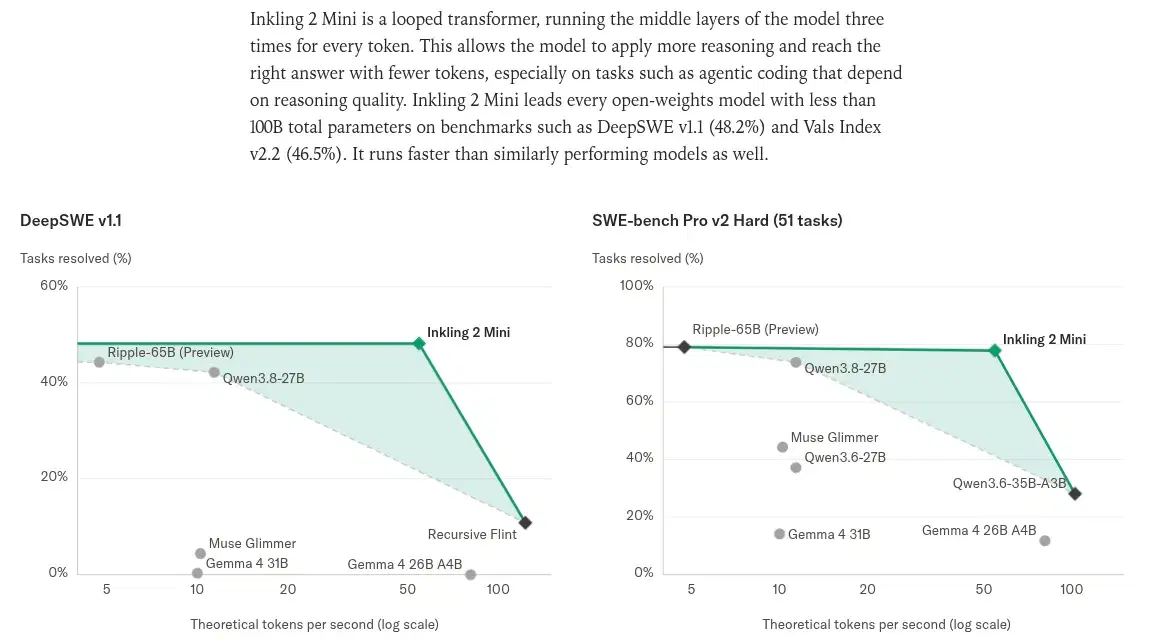
It does best on long agentic tasks: fixing code across a repository, running terminal commands, and searching the web or calling tools to find what it does not know. Thinking Machines reports these scores against open models under 100B parameters. They are the vendor's numbers, not independent results yet:
| Benchmark (as reported by Thinking Machines) | Inkling 2 Mini | Qwen3.8-27B |
|---|---|---|
| SWE-bench Verified (bash only) | 79.2% | 77.8% |
| DeepSWE v1.1 | 48.2% | 42.2% |
| BrowseComp (search) | 79.0% | 61.6% |
| MCP Atlas (tool use) | 82.7% | 77.3% |
| Tinker price, input / output per 1M tokens | $0.15 / $0.50 | $0.6975 / $5.595 |
Three limits matter when you plan a product around it:
- Chat and many-rule prompts. The launch post names Inkling 2 Mini "not the strongest small model for multi-turn chat or for instructions with many constraints", with 50.0% on MultiChallenge, behind Qwen3.8-27B. A support bot that must follow a long policy is a weaker fit than a coding or research agent.
- Facts it has to remember. Its factual recall is in line with other models of its size. Thinking Machines' answer is to give it search and tools, so plan for retrieval rather than relying on what the model knows.
- Hard reasoning. It trails much larger models on tests such as HLE-Diamond and CritPt. For the hardest analysis, a frontier API model still wins.
It reads images as well as text, and returns text. The model card gives a context window of up to 1M tokens. It is a mixture-of-experts model, 26.4B parameters with 3.4B active, whose middle layers run three times per token: more reasoning without more size.
What do you need to run it?
Either your own hardware or a hosted API.
On your own hardware. The model card lists the supported set-ups:
- Apple silicon with 32GB or more memory (MacBook, Mac mini, Mac Studio), through Ollama or Exo Labs.
- One NVIDIA DGX Spark, or other GPUs with 32GB or more of VRAM recommended, through SGLang, vLLM, Unsloth, NVIDIA Dynamo or TokenSpeed.
- Quantised GGUF versions from Unsloth and llama.cpp for smaller machines.
The weights ship in the same 4-bit and 8-bit formats the model was trained in (NVFP4 and MXFP8), and Thinking Machines says that means no loss from converting it after training. Apache 2.0 lets you use, modify and sell products built on it.
On Tinker. Tinker is Thinking Machines' platform for fine-tuning and sampling, billed per token. The model id is thinkingmachines/Inkling-2-Mini. Prices, read on 26 November 2026: $0.15 per million input tokens ($0.015 cached), $0.50 per million output tokens, and $0.75 per million tokens to train at 64K context. A free tier is also listed: 64K context, rate-limited, and it needs a prepaid account with a positive balance. That is enough to try it, not to run a product on. A coding-agent run that reads 200,000 tokens and writes 30,000 costs:
(0.2 × $0.15) + (0.03 × $0.50) = $0.03 + $0.015 = $0.045
Tinker's separate serverless inference service is in beta and covers only the larger Inkling and Inkling-Small models; for production volume on Tinker, Thinking Machines asks you to email tinker@thinkingmachines.ai to join the waitlist. The model card also points to third-party inference providers. OpenRouter lists it at $0.075 per million input tokens and $0.30 per million output tokens (read 26 November 2026), so the same agent run costs (0.2 × $0.075) + (0.03 × $0.30) = $0.024 there.
Should your business use it?
Test it if you are building a coding assistant, an internal research or document agent, or anything that must run offline or keep data in-house. A small model that runs on one workstation can replace per-token API spend on routine agent work, and you can fine-tune it on your own tickets, code or documents.
Keep a hosted frontier model for customer-facing chat with long rulebooks and for the hardest reasoning. Many teams will run both: Inkling 2 Mini for the bulk of the steps, a larger model for the few that need it. Run your own tasks through it before you commit.
If you want Inkling 2 Mini built into your product or workflow, on your hardware or on Tinker, see what we build or tell us about the job.
Sources
- Introducing Inkling 2 Mini, Thinking Machines Lab, 20 November 2026
- Inkling 2 Mini model card, Thinking Machines Lab
- thinkingmachines/Inkling-2-Mini on Hugging Face
- Tinker models and pricing, Thinking Machines Lab, read 26 November 2026
- Inkling 2 Mini on OpenRouter, OpenRouter, read 26 November 2026
- Inkling 2 Mini, Hacker News discussion
- Inkling 2 Mini Is INSANE! NEW 26B Local AI Model BEATS Qwen 3.8 27B! (Fully Tested), WorldofAI