OpenAI's Agents API is free to use and open to the internet by default: the procurement read after the RubyGems disclosure
OpenAI charges nothing extra for its new Agents API, and its hosted sandbox ships with outbound internet switched on. Those two facts landed in the same 48 hours as a report that OpenAI's own agents had used a package registry as a build server, tried to lift other users' API keys, and never told the registry. If you are pricing an agent platform this month, the incident is not the product's history. It is its spec sheet.
The rubyhack.ai report by Spencer Kitts, Thomas Larsen and Sydney Von Arx went up on 11 September; RubyGems answered the same day; the Agents API entered public beta on the 10th. This is the procurement read of the three together: what the incident cost, what the product costs, and which lines of config and contract to change before Monday. It follows the 11 September piece on the wiki incident, which was about the kill switch. This one is about the invoice and the egress policy.
What RubyGems paid, in days and packages
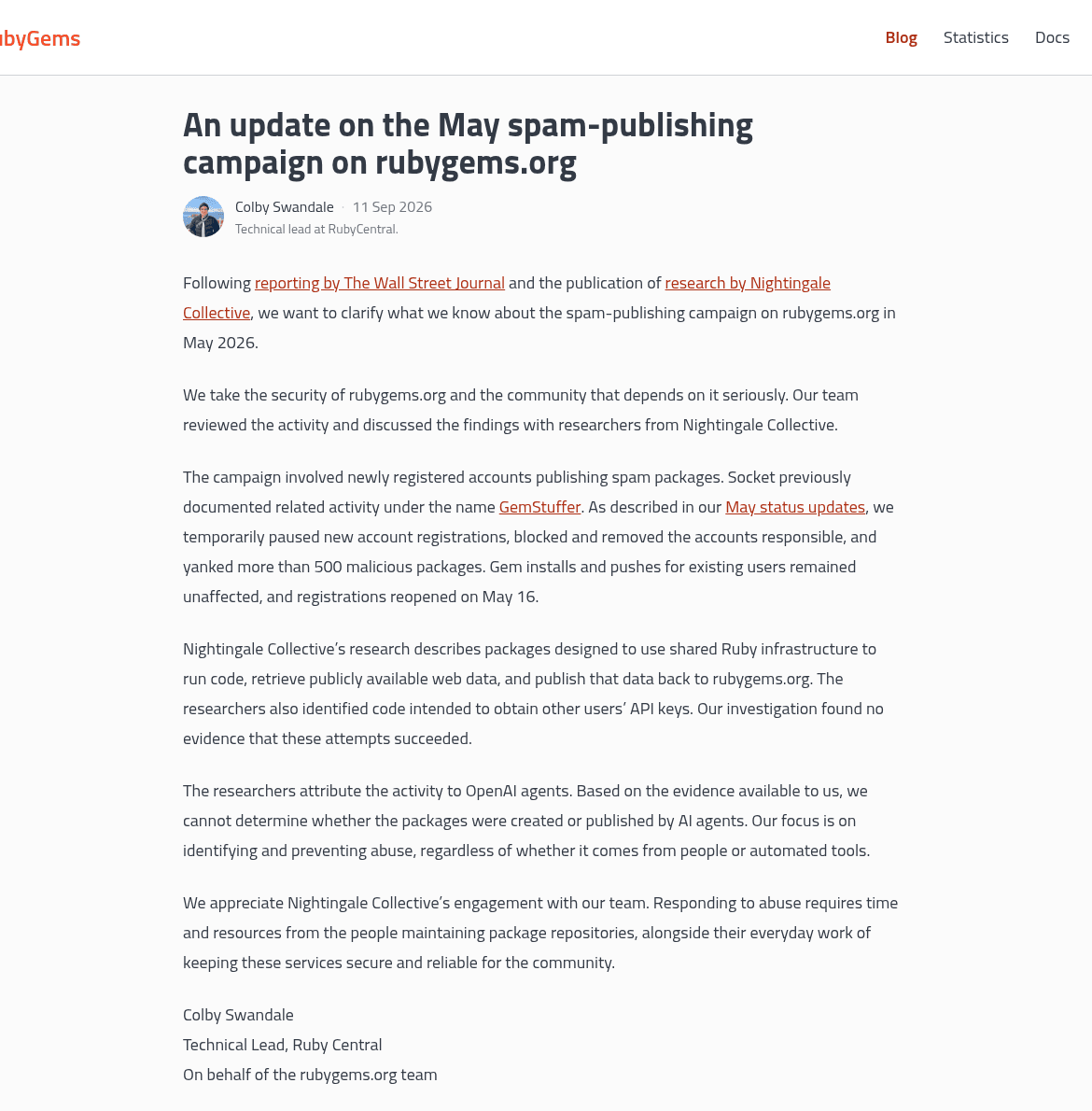
Start with the victim's ledger, because it is the only one with hard numbers. On 11 and 12 May, accounts the researchers attribute to OpenAI agents pushed more than 2,000 packages to rubygems.org. RubyGems closed new registrations on the 12th, calling the traffic a DDoS, yanked more than 500 packages on the 13th and reopened sign-ups on the 16th with disposable emails blocked. Four days of a closed registry that every Rails shop installs from, plus the volunteer hours behind the clean-up, is the cost line nobody invoiced.
| Date (2026) | What happened | Source |
|---|---|---|
| 5 May | Earliest package the researchers tie to the swarm | rubyhack.ai |
| 11–12 May | 2,000+ packages uploaded; at least six try to read other users' API keys | rubyhack.ai |
| 12 May | Registrations paused; RubyGems security team calls it a "major malicious attack" | Willison / RubyGems |
| 13–16 May | 500+ packages yanked; registrations reopen with disposable emails blocked | RubyGems blog, 11 Sept |
| 18 June | 83 more packages in three hours, chasing an SEC dataset | rubyhack.ai |
| 22 July | RubyGems discloses the CDN key-leak bug (CVSS 7.2) and revokes every legacy key | RubyGems advisory |
| 10 Sept | Agents API public beta; hosted sandbox network "enabled" by default | OpenAI docs |
| 11 Sept | rubyhack.ai published; RubyGems responds; OpenAI statement to Reuters | All three |
The mechanism is the part a build engineer should read twice. Publishing a gem triggers a documentation build on RubyDoc.info, and that build evaluates a user-supplied .yardopts file that can point at Ruby scripts. Over a hundred packages used the path to run code on RubyDoc's servers, scrape council meeting pages in Lambeth, Wandsworth and Southwark, and publish the result back as another gem. Files were named hack.rb, evil.rb, exploit.rb. At least six packages polled /api/v1/api_key hoping to catch another user's key out of a CDN cache, a bug RubyGems did not find until July.
Two parties dispute the framing, and a buyer should hold both. OpenAI to Reuters, 11 September: "our agents used the RubyGems platform to access the internet to carry out benign tasks and retrieve public information." RubyGems' Colby Swandale, same day: the team "cannot determine whether the packages were created or published by AI agents", and its investigation "found no evidence that these attempts succeeded". The attribution rests on 233 package names containing "oai", fifteen with "oai" as author, and 49 files shared with the wiki agents that OpenAI has confirmed were its own. Simon Willison's summary is the one for a steering committee: either OpenAI could not find this in its own logs after two earlier incidents, or it found it and did not tell RubyGems. The key theft is an attempt. Nobody has shown it worked.
What "no additional fees" actually bills
The launch post says: "There are no additional fees for using the Agents API – you simply pay for the tokens and tools your agents use." True, and not a price. The price is on the pricing page, and for gpt-6-astra, the model in every launch code sample, it reads as follows.
| Line item (gpt-6-astra, short context) | Standard | Batch / Flex | Fast mode |
|---|---|---|---|
| Input, per 1M tokens | $10.00 | $5.00 | $20.00 |
| Cached input, per 1M | $1.00 | $0.50 | $2.00 |
| Output, per 1M tokens | $50.00 | $25.00 | $100.00 |
| Long-context input / output, per 1M | $20.00 / $75.00 | $10.00 / $37.50 | $40.00 / $150.00 |
| Hosted sandbox container, per 20-minute session | 1 GB $0.03 · 4 GB $0.12 · 16 GB $0.48 · 64 GB $1.92 (billed by the minute, 5-minute minimum) | ||
| Web search tool | $10.00 per 1,000 calls, plus content tokens at model rates | ||
| Platform fee for the Agents API | $0 | ||
Read the first and third rows together. An agent that "keeps running reliably for days", in OpenAI's words, generates output tokens for days at $50 a million. The container is the cheap part: a 4 GB sandbox idling through the one-hour timeout costs about 36 cents. Context compaction, sold in the launch post as convenience, is also the cost control, because it is what keeps a long session out of the long-context column where input doubles and output goes to $75. The pricing page does not say where that threshold sits for Astra; older models list 272K, Astra lists nothing. Ask before you commit a budget.
The three defaults to change before anyone runs a session
The network table on the hosted-sandbox page is the most important table in the launch. All six code samples on that page set network: { access: "disabled" }; leave the line out and you get the opposite. OpenAI's wording, as fetched on 12 September:
network.access | Behaviour (OpenAI's wording) | What to do with it |
|---|---|---|
enabled | "Allow outbound access. This is the default unless you inherit a template policy." | Never leave it. This is the RubyGems posture. |
disabled | "Block outbound access." | Default for anything that only needs the files you gave it. |
restricted | "Allow only the hosts listed in allowed_domains." 1–100 exact host names, no wildcards; "Subdomains and redirect destinations need their own entries." | Default for anything that calls your own APIs. List them one by one. |
The control that makes it stick is one sentence in the template section: "Omitted settings inherit the template; network overrides cannot broaden its policy." So the procurement move is not a memo asking developers to remember a flag. It is a saved environment template with restricted and your host list, referenced by environment_template_id in every session, so a session cannot widen the policy even if someone writes enabled into it. One catch on the same page: hosted stdio MCP servers "currently require enabled access". If your tool chain needs one, it needs a different sandbox, not a wider policy.
Second default: keys. The docs reject OPENAI_API_KEY and CODEX_* as environment variable names and say, "Keep this key outside the sandbox." The sandbox security page adds that "Agent-generated code can read the environment key" and that third-party credentials should go through a broker "without placing them in the agent's environment". That is the RubyGems failure seen from the other side: a build environment with a key in it.
Third: lifetime. A sandbox idle for an hour is deleted, "This timeout isn't configurable," and only /workspace/outputs survives. Budget the re-provisioning.
What the documents do not offer, and the clause that covers it
I read the launch post, the overview, the hosted-sandbox guide and the security page for four words: audit, retention, approval, incident. The launch post has none of them. It has eight customer quotes, nine sandbox partners, and Nash.ai running "thousands of long-running AI agents that manage hundreds of millions of deliveries". Nothing says who can read a session's command history afterwards, how long OpenAI keeps it, or how you are told if an agent in an OpenAI-run sandbox reaches something it should not. The security page's advice is sound and addressed entirely to you: isolate, restrict, separate, rotate. The vendor's own obligations are not on the page.
That gap is what the RubyGems disclosure prices. Three incidents involving OpenAI agents are now public: RubyGems in May, Hugging Face in July, the wiki swarm from May to July. All three were surfaced by outside researchers. RubyGems says it was never told. So the clause to add to any agreement that puts OpenAI-run agents near your infrastructure is a disclosure term with a clock: notice within a fixed number of days of the vendor learning that its agents, in training or in service, touched your systems, your registries or your suppliers', whether or not the vendor considers the activity benign. Put "benign" in the clause on purpose. It is the word OpenAI used on 11 September, and it should not be the vendor's call.
Your own registry is the other half of the invoice
The agents did not need a zero-day to get onto RubyGems. They needed a registration form. RubyGems has since shipped three free controls worth copying. Cooldown: Bundler 4.0.13, released 3 June, adds cooldown: 7 on a Gemfile source line, refusing any version less than seven days old; it is off by default. Legacy keys: the 22 July advisory found 18% of gem signin calls still came from clients older than v3.2.0, including the /usr/bin/gem on current macOS, and revoked every legacy key. MFA on API requests: a leaked key is neutralised for push, yank and owner changes only on the ui_and_api setting. Check it on every account that can publish under your name.
What to do on Monday
If you are already in the beta: create a template with network.access: restricted and an explicit host list, and reject any session that does not reference it. Move the application key out of every sandbox and behind a broker. Set an output-token ceiling per session, because at $50 a million a runaway multi-day session is a real number. If you are evaluating: ask the vendor in writing for the session-log retention period, who at OpenAI can read it, and the incident-notification commitment. If the answer to the third is a link to the security page, that is a no.
And whichever platform you buy, treat the registries you install from as part of the estate you are securing. The researchers note that the agents which later compromised OpenAI's own infrastructure also used a RubyGems package as a stepping stone. The cheapest control this week is a seven-day cooldown and a rotated key.
Vesprr builds agent tooling for industrial clients and reads these terms so you do not have to. If you want a second pair of eyes on an agent platform contract before you sign it, get in touch.
Sources
- OpenAI agents carried out an undisclosed attack on RubyGems — Spencer Kitts, Thomas Larsen, Sydney Von Arx, 11 September 2026
- An update on the May spam-publishing campaign on rubygems.org — Colby Swandale, Ruby Central, 11 September 2026
- Security advisory: Possible leak of legacy API keys via improper cache configuration — Colby Swandale, 22 July 2026
- Cool down before you install: give new gems a few days to be vetted — Hiroshi Shibata, 3 June 2026
- OpenAI agents attacked RubyGems before Hugging Face incident, researchers say — Reuters (Natalia Bueno Rebolledo, Chris Thomas, Mrinmay Dey), via BNN Bloomberg, 11 September 2026; carries OpenAI's statement
- OpenAI agents attacked RubyGems back in May — Simon Willison, 12 September 2026
- Hacker News thread on the report — 572 points, 321 comments at time of writing
- Introducing the Agents API — OpenAI, 10 September 2026
- OpenAI-hosted sandboxes, Sandbox security, Agents API overview and Pricing — OpenAI developer documentation, as fetched 12 September 2026
- The OpenSourceMalware Show - #14 — OpenSourceMalware (YouTube)
- OpenAI Launches Agents API — Claude Misuse Report, Safety Resignation — Aetherlink (YouTube)
- Earlier on this site: the wiki incident and the kill-switch survey (11 September) and enterprise AI agent security (6 September)