What is Gemini 4 Carbon? Google's model for the hardest jobs
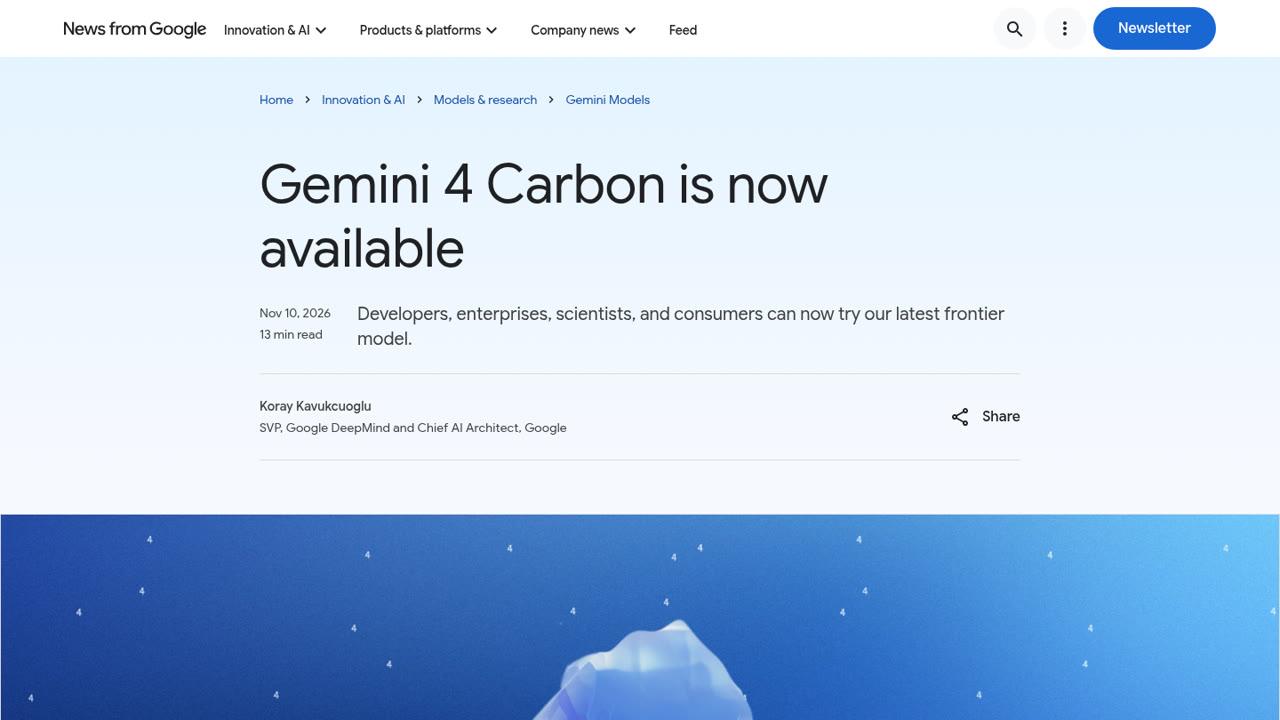
Gemini 4 Carbon is Google's strongest reasoning model, generally available since 10 November 2026 on the paid Gemini API, in AI Studio and in Gemini for business. It costs the same per token as Gemini 4 Argon, $2 per million input tokens and $10 per million output tokens until 30 November, then $4 and $20. It thinks for longer than Argon on each task, so each task costs more and takes longer. Use it for the hardest debugging, design, document and security work, and keep Argon for everyday coding and production loops.
Google first announced Carbon on 28 October and gave it only to cyber defenders in its Fairwind Program. The 10 November release opened it to every paying developer and business. Google AI Ultra subscribers also get it in the Gemini app, AI Mode in Search and Google Antigravity. The model id is gemini-4-carbon. It takes text, images, video, audio and PDFs, returns text, and has a 1,048,576-token window shared by input, thinking and output.
Carbon or Argon?
Start on Argon, and move a job to Carbon when Argon gets it wrong. Google's own guidance draws the line on thinking tokens: the two models share the same context window, tools and per-token price, but Carbon "spends more thinking tokens per turn to explore thoroughly and verify its work". Google recommends it for root-cause debugging, architectural design, synthesis across dense documents, scientific proofs and security audits. Argon stays the faster, cheaper choice for interactive coding and day-to-day feature work.
Google's evidence for Carbon, from its launch post:
- Ranked first on CursorBench 4.0, Perplexity's WANDR and Zapier's AutomationBench, at less than half the cost per task of the next best model from another company.
- 88.2% on SEC-bench Pro (finding vulnerabilities), 54.8% on ExploitGym and 71.0% on CWE-bench (patching), measured without guardrails.
- About half as many unsupported claims as Argon in Google's internal tests, and 92% of tasks passed on its 375-task agentic honesty benchmark, against 70% for Argon.
These are the vendor's numbers and the vendor's chosen customers. One of them, HubX, reported this on legacy code:
"Across 16 real bug fixes in our 14,000-test codebase, Carbon achieved a 94% resolution rate with zero regressions." Baki Celtik, AI Engineer, HubX, quoted by Google
Before you decide, run your own tasks at low, medium and high thinking, as Google's docs advise, and keep the lowest level that meets your bar.
What does a Carbon job cost?
Count the thinking. Thinking tokens are billed as output, so Carbon's price per token matches Argon but its bill per task does not. Prices from Google's pricing page, read 12 November 2026:
| Model | Input / 1M tokens | Output / 1M tokens | Notes |
|---|---|---|---|
| Gemini 4 Carbon | $2 to 30 Nov, then $4 | $10 to 30 Nov, then $20 | Paid tier only. Cached input 95% off. |
| Gemini 4 Argon | $2 to 30 Nov, then $4 | $10 to 30 Nov, then $20 | Fewer thinking tokens per turn |
| Claude Fable 5.2 | $8 | $40 | Anthropic's top model, for comparison |
A worked example: a code review that sends 200,000 tokens of repository and gets back 30,000 tokens of thinking and answer.
- Until 30 November: 0.2 × $2 + 0.03 × $10 = $0.40 + $0.30 = $0.70.
- From 1 December: 0.2 × $4 + 0.03 × $20 = $0.80 + $0.60 = $1.40.
- The same token counts on Fable 5.2: 0.2 × $8 + 0.03 × $40 = $1.60 + $1.20 = $2.80.
Token counts differ between models, and Carbon uses more than Argon on hard prompts, so treat this as a ceiling to test against, not a quote. If you repeat the same long prompt, implicit caching applies from 4,096 tokens and drops cached input to $0.10 per million ($0.20 from 1 December).
If you plan to move a workload, the introductory price makes November the cheap month to measure it.
What changes in your code if you switch?
From Argon, only the model string changes. From Gemini 3 or earlier, Google's migration checklist lists five things that break or cost more:
- Explicit context caching is not supported. Remove
cachedContentscalls and rely on implicit caching. temperature,top_pandtop_kare ignored.- Raise
max_output_tokensto at least 32,768, because thinking shares that limit with the answer. - Set HTTP timeouts to at least 15 minutes, or use background execution. Hard prompts can take several minutes.
- For answers longer than 64K tokens, set
backgroundto true. A single response can then run up to 1M tokens minus your input.
Want Carbon, or a cheaper model where it is enough, built into your product or workflow? See what we build or tell us about the job. For Google's previous model, read What is Gemini 4 Argon?; for Anthropic's rival, What is Claude Fable 5.2?
Sources
- Koray Kavukcuoglu, Google: Gemini 4 Carbon is now available (10 Nov 2026, read 12 Nov 2026)
- Koray Kavukcuoglu, Google: Introducing Gemini 4 Carbon (28 Oct 2026)
- Google AI for Developers: What's new in Gemini 4 Carbon (read 12 Nov 2026)
- Google AI for Developers: Gemini 4 Carbon model page (read 12 Nov 2026)
- Google AI for Developers: Gemini API pricing (read 12 Nov 2026)
- Google AI for Developers: Gemini API release notes (read 12 Nov 2026)
- Anthropic: Claude pricing (read 12 Nov 2026)