
What is Jev? TypeSafe AI's model that returns types, not text
Jev is a model that returns a typed value instead of a sentence. You send it a block of text and a typed question — which of these categories, which level on this scale, is this true — and you get the answer back as a value your code can use, together with the probability distribution it came from. It is TypeSafe AI's first model, in early access since 15 September 2026, and input costs $0.042 per million tokens with output tokens free.
That makes it a candidate for one specific job: the classify, route, score, extract and validate calls buried inside an automation pipeline. It is not a candidate for anything that needs a paragraph back. TypeSafe's own documentation says Jev is "not trained to generate text" and that asking it to "will not work well and will be very slow".
What comes back
Three question types, and each returns a value plus the numbers behind it. Choice answers "Which of these options?" and returns the choice, the probabilities across your options, and a confidence figure. Score answers "Which level?" against an ordered list of levels you define, and returns the score, the legend, probabilities and confidence. Noul answers "Is this true?" and returns one number between 0 and 1. You can mix all three in a single request, and the model evaluates every question in a request in parallel against the same state.
Read the confidence field carefully, because it is the one most likely to be misread. It is not the model's probability of being right. The docs define it as "a statistic computed from the probability distribution the answer already gives you" — a measure of how concentrated that distribution is — and add that "you are never locked into our definition". The probabilities are the trained output; confidence is arithmetic on top of them, and you can do your own arithmetic instead.
The operating limits, from the model page read on 24 September 2026: one endpoint, with the model id jev-1.13.0 or the aliases jev-latest and jev-preview. 64k tokens per request, of which 32k is the budget for your state plus the longest question. Text only — no image, audio or video. English first, with other languages "handled but not equally well".
What it is bad at
TypeSafe publishes that list itself, per model version, and for jev-1.13 it is the page to read before you plan anything. Jev is literal: it "answers the question you wrote, not the one you meant". It does not count reliably, because it "recognizes the shape of an answer rather than tallying, and the error grows". It reads dates "as text, not as ordered quantities", so date comparison is unreliable and gets worse when formats are mixed. It struggles with numeric precision and with double negatives. Accuracy falls as the state grows with content unrelated to the decision, and content written to steer the model adversarially can move the answer.
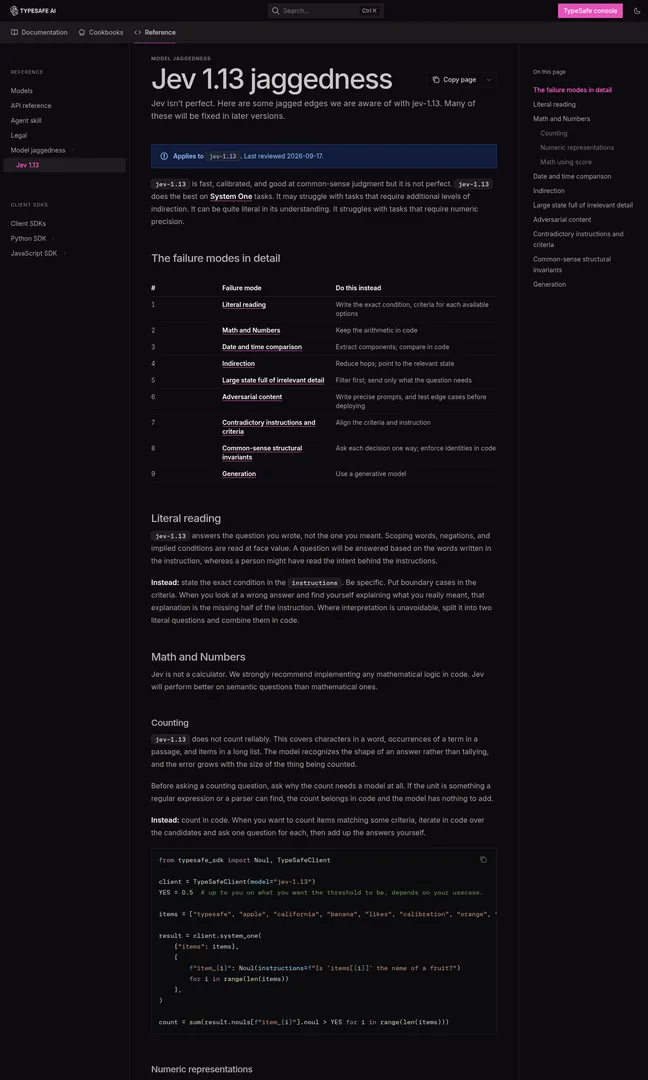
One more matters if you plan to combine answers: structural invariants are not guaranteed. A question and its negation will not necessarily sum to 1. If your logic depends on that, measure it rather than assume it.
Whether to try it
Try it if a measurable share of your model spend is single-decision calls — classify this ticket, route this document, is this invoice a duplicate — and if you can label a few hundred real examples to test against. Access is early access by waitlist through the TypeSafe console, with enterprise arrangements through the company's sales address. Published rate limits are 250,000 tokens per second and 1,200 requests per minute, and the docs warn that they are "adjusting dynamically" and can change without notice, so do not size a production system on them yet.
Wait if you need an independent benchmark, because there is not one. TypeSafe publishes its own workflow evals and describes the headline figures — 193.6x faster, 444.6x cheaper — as the higher end of real-world gains. Those are the vendor's workflows, written by the vendor's team. The price is the one figure you can check without trusting anybody.
The question worth answering this week is not whether Jev is good. It is what share of your pipeline is a decision rather than a sentence, because that share is the size of the saving. The companion piece on Jev's pricing works that arithmetic through on a document-classification job.
To have that share measured against your own traffic and the result built into your product, Vesprr does that work — or tell us what you are routing.
Sources
- Introducing System One Models & Jev, TypeSafe AI, 15 September 2026 (release date, price, speed claims)
- Primitives (Questions), Confidence, Models and Jev 1.13 jaggedness, TypeSafe AI docs, all read 24 September 2026 (return values, confidence definition, model ids, limits, failure modes)
- Workflow evals, TypeSafe AI (the vendor's own eval suite)
- OpenAI hacked, Jev, Google's RSI, Qwen 3.8 Omni, Bonsai 2, new Gemini Live: AI NEWS, AI Search (YouTube), used as a signal of what people are asking about; no fact in this piece comes from it