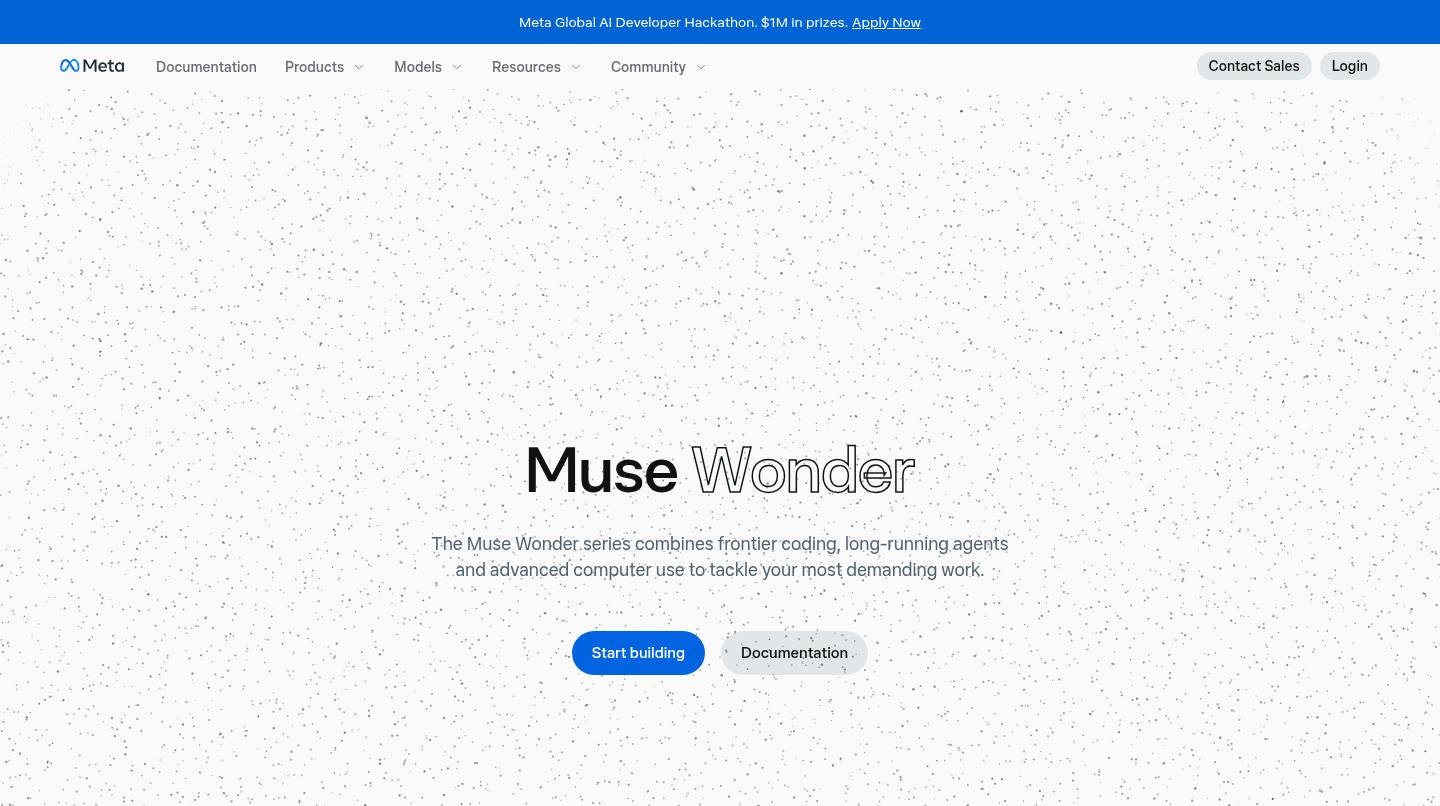
What is Muse Wonder? Meta's frontier model for agents
Muse Wonder is Meta's most capable model, released on 12 October 2026 for coding and long-running agent work. You can call it today on the Meta Model API as muse-wonder-1.0, at $4 per million input tokens and $20 per million output tokens. That is the same token price as Claude Opus 5.5, so the question is which one does your job better, not which is cheaper.
Meta's docs still label it a preview. A stronger variant, Muse Wonder Full, is not on the API at all: you only get it inside Meta's Muse Code tool, on a paid plan.
What is it built to do?
Muse Wonder is aimed at long, multi-step work: changes across many files in a real repository, agents that run for hours, sub-agents, parallel tool calls and computer use. Meta's docs list chat, image, video and audio understanding, tool calling, structured output and search grounding. It takes text, image, video, audio and PDF input, returns text, and has a 1,048,576-token context window, with reasoning effort from "minimal" to "max".
Meta's announcement adds two named features:
"Active Memory, the ability to carry what matters to you across conversations" and "Active Focus, the ability to keep working toward your goal when a task gets hard." — Meta newsroom, 12 October 2026
Meta says a full safety report "will be available soon". If you need one for a compliance review, it is not out yet.
How does it compare?
On Meta's own benchmark table, Muse Wonder leads on long-horizon coding but trails Claude Opus 5.5 on the Artificial Analysis index and on terminal coding. These are Meta's published figures, run at each model's "max" setting.
| Benchmark | Muse Wonder | Wonder Full | Claude Opus 5.5 | Claude Fable 5.1 | GPT-6 Astra |
|---|---|---|---|---|---|
| Artificial Analysis Index | 52 | 56 | 58 | 53 | 53 |
| DeepSWE 1.1 (long-horizon coding) | 78.8 | 79.0 | 74.2 | 67.4 | 74.1 |
| Terminal-Bench 4.0-AA | 52.0 | 57.1 | 59.6 | 52.0 | 59.1 |
A view, not a fact: at equal prices, run your own tasks through both Muse Wonder and Opus 5.5 before you choose. The table points in both directions.
What does it cost for a real job?
Token prices on Meta's pricing page, read 18 October 2026: input $4.00, cached input $0.20, output $20.00 per million tokens. There is no long-context premium. Web search grounding adds $2.50 per 1,000 searches.
Take one coding-agent task that sends 200,000 input tokens, 150,000 of them from cache, and returns 20,000 tokens:
- Uncached input: 50,000 × $4 / 1,000,000 = $0.20
- Cached input: 150,000 × $0.20 / 1,000,000 = $0.03
- Output: 20,000 × $20 / 1,000,000 = $0.40
- Total: $0.63 per task, or $630 for 1,000 tasks
Claude Opus 5.5 lists the same $4, $0.20 and $20 rates on Anthropic's pricing page, read the same day, so the token cost of that task is the same on both.
Muse Wonder Full has no per-token price. It comes with Muse Code's Power Usage plan at $50 a month or Maximum Usage at $200 a month, and works only through the Muse Code CLI.
What should you check before you build on it?
Five things in Meta's docs change how you would use it in a product:
- Switching is cheap. Muse Wonder and Muse Spark take the same requests on the same endpoints (Responses, Chat Completions and Messages), so moving a workload between them is a model ID change. The quick start points an OpenAI-SDK-compatible client at the Meta Model API.
- Your data. On the API, Muse Wonder runs in Standard mode only, where your prompts and outputs are not used to train Meta models. Muse Code subscriptions default to Contributor mode, which does allow training; you can turn it off in settings.
- Limits. 3,000 requests and 4,000,000 tokens per minute, counted per team, not per API key.
- Preview status. Plan for the model ID, limits and behaviour to change before it is final.
- Self-hosting. Muse Wonder runs on Meta's API, Muse Code and OpenRouter. If you need weights on your own servers, Meta's open-weight model is Muse Spark Open, an 816-billion-parameter mixture-of-experts model with 42 billion active, under Meta's Muse Model License. Even its 4-bit checkpoint needs a four-GPU Blackwell node, so check the licence and hardware page first.
If you want Muse Wonder, or a model chosen against it, built into your product or workflow, see what we build or tell us about the job.
Sources
- Introducing Muse Wonder and Muse Wonder Full: Frontier Models for Agents — Meta newsroom, 12 October 2026
- Muse Wonder model page and benchmark table — Meta, read 18 October 2026
- Models documentation — Meta Model API docs, read 18 October 2026
- Pricing and rate limits — Meta Model API docs, read 18 October 2026
- Muse Code subscriptions — Meta Model API docs, read 18 October 2026
- Muse Spark Open overview — Meta Model API docs, read 18 October 2026
- Pricing — Anthropic, read 18 October 2026
- Meta's Muse Wonder IS OPUS 5.5 LEVEL?! I Don't Think So... (Fully Tested) — WorldofAI, YouTube (flagged the release)
More in this series: Claude Opus 5.5 pricing: $4 in, $20 out, and what a job costs.