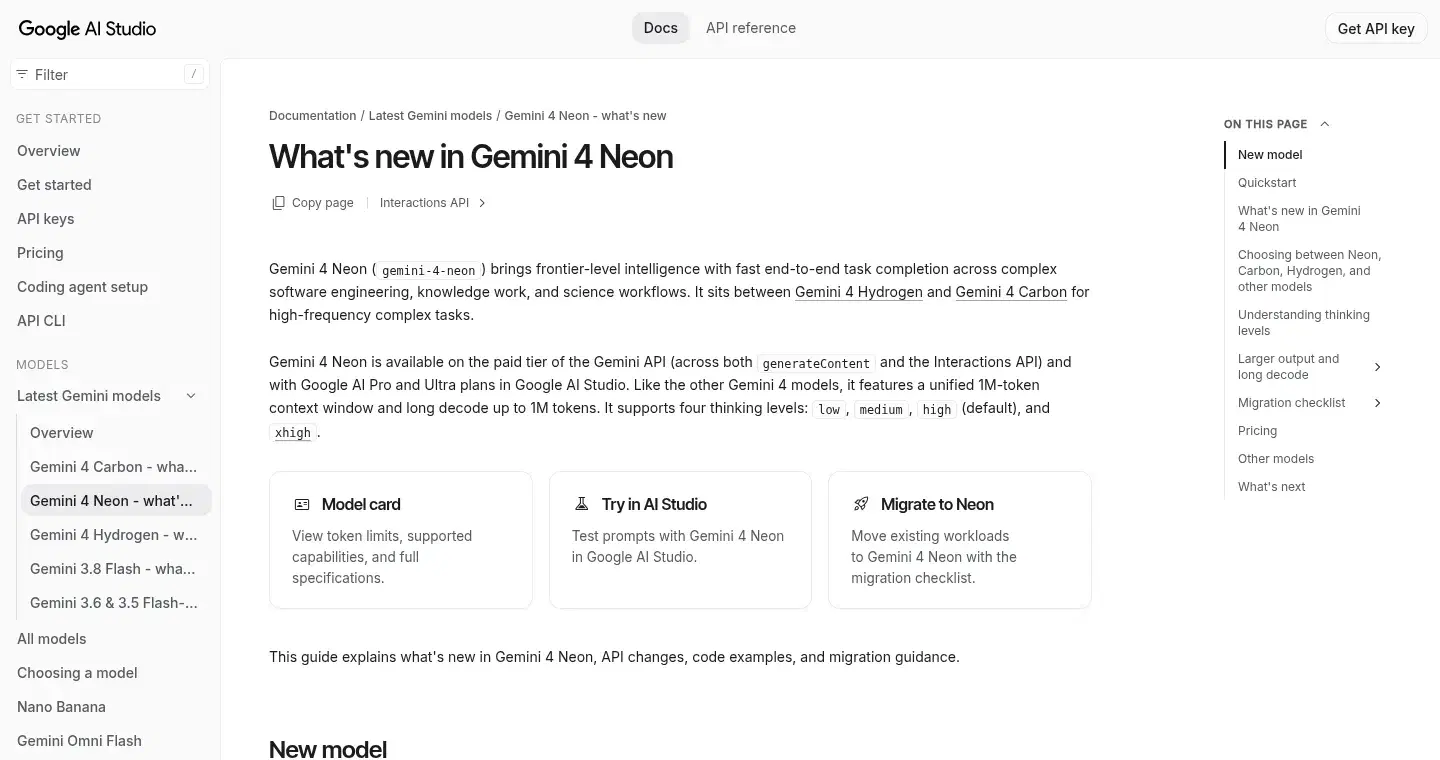
What is Gemini 4 Neon? Google's model between Hydrogen and Carbon
Gemini 4 Neon is Google's new middle model in the Gemini 4 family, generally available since 18 November 2026 on the paid Gemini API as gemini-4-neon. It sits between Gemini 4 Hydrogen, the fast everyday model, and Gemini 4 Carbon, the strongest reasoner, and costs a flat $3 per million input tokens and $15 per million output tokens. Use it for multi-file coding, dense documents and analysis where Hydrogen falls short and you do not need Carbon's slower, more thorough checking.
It takes text, images, video, audio and PDFs and returns text. Input, thinking and output share one 1,048,576-token window. A single response stops at 65,536 tokens unless you turn on background execution, which runs up to the full window. Neon is not on the free tier. Google AI Pro and Ultra subscribers can also pick it in the Gemini app, AI Studio and Google Antigravity.
Neon, Hydrogen or Carbon?
Start on Hydrogen, move a job to Neon when Hydrogen gets it wrong, and keep Carbon for the problems Neon cannot crack. That is Google's own guidance: Neon "finishes faster with fewer output tokens than Carbon while handling harder reasoning than Hydrogen". All three share the same request format, context window and tools, so you can send each step of a workflow to a different model.
| Model | Speed | Default thinking | Price per 1M tokens (in / out) |
|---|---|---|---|
| Gemini 4 Hydrogen | Fast | high (up to xhigh) | $1.50 / $7.50, free tier available |
| Gemini 4 Neon | Moderate | high (up to xhigh) | $3 / $15, paid only |
| Gemini 4 Carbon | Deliberate | medium (up to high) | $2 / $10 to 30 Nov, then $4 / $20, paid only |
Google's evidence, from its launch post: first on the Artificial Analysis Coding Agent Index (58.6), 65.2% on Terminal-Bench 4.1, second on the Vals Index (70.9%), and 90.5% on SEC-bench Pro for finding vulnerabilities. These are the vendor's chosen benchmarks. One customer Google quotes, Glean, put the trade-off this way:
"In our early evaluations, it matched or exceeded Gemini 4 Carbon on overall quality at 3x the speed and 60% of the cost." Thai Tran, AI Product Lead, Glean, quoted by Google
Test it on your own tasks before you switch. Google's docs say to run your evaluations at all four thinking levels (low, medium, high, xhigh) and keep the lowest level that meets your bar.
What does a Neon job cost?
Per token, Neon costs more than Carbon until 30 November and less from 1 December, when Carbon's introductory price ends. Thinking tokens are billed as output, so the bill per task depends on how much each model thinks. Prices are from Google's pricing page, read 19 November 2026.
A worked example: a code review that sends 200,000 tokens of repository and gets back 30,000 tokens of thinking and answer.
- Neon: 0.2 × $3 + 0.03 × $15 = $0.60 + $0.45 = $1.05.
- Carbon until 30 November: 0.2 × $2 + 0.03 × $10 = $0.40 + $0.30 = $0.70. From 1 December: 0.2 × $4 + 0.03 × $20 = $0.80 + $0.60 = $1.40.
- Hydrogen: 0.2 × $1.50 + 0.03 × $7.50 = $0.30 + $0.225 = $0.53.
Real token counts differ by model. Google says Neon uses fewer output tokens than Carbon, and claims a 32% lower cost per task at the default high level, so run your own jobs to see your real cost. Batch and Flex halve Neon's price to $1.50 / $7.50. Repeated prompts of 4,096 tokens or more get implicit caching, which cuts cached input to $0.15 per million.
How do you call it?
From Carbon, Argon or Hydrogen, change the model string to gemini-4-neon and nothing else; Google's migration checklist says no request changes are needed. Check the thinking level: Neon defaults to high, while Carbon and Argon default to medium. This is Google's Python quickstart, verbatim from the docs (read 19 November 2026):
from google import genai

client = genai.Client()

interaction = client.interactions.create(
    model="gemini-4-neon",
    input="Build an interactive single-file HTML token bucket rate-limiter simulator with live sliders for burst size and request traffic."
)
print(interaction.output_text)
Coming from Gemini 3 or earlier, these are the changes from the checklist that matter most:
- Remove explicit caching (
cached_contentfields). Only implicit caching is supported. - Remove
temperature,top_pandtop_k. Out-of-range values return a 400 error. minimalthinking is rejected with an error.- Remove low
max_output_tokenscaps such as 8,192, because thinking counts against that limit. - Set HTTP timeouts to at least 15 minutes, or use background execution.
Want Neon, or a cheaper model where it is enough, built into your product or workflow? See what we build or tell us about the job. For the rest of the family, read What is Gemini 4 Carbon? and What is Gemini 4 Argon?
Sources
- Koray Kavukcuoglu, Google: Introducing Gemini 4 Neon (18 Nov 2026, read 19 Nov 2026)
- Google AI for Developers: What's new in Gemini 4 Neon (read 19 Nov 2026)
- Google AI for Developers: Gemini 4 Neon model page (read 19 Nov 2026)
- Google AI for Developers: Choosing a model (read 19 Nov 2026)
- Google AI for Developers: Gemini API pricing (read 19 Nov 2026)
- Google AI for Developers: Gemini API release notes (read 19 Nov 2026)